Unbounce Review 2026: Best Landing Page Builder for Conversions
Landing pages determine marketing campaign success. A well-optimized landing page converts visitors into customers, while a poorly designed one wastes advertising spend and lost opportunities. Unbounce has established itself as a leading landing page platform focused specifically on conversion optimization. This comprehensive review examines whether Unbounce delivers on its promise to help marketers create high-converting landing pages without coding knowledge.
What Is Unbounce
Unbounce is a specialized landing page builder designed for marketers running paid advertising campaigns. Founded in 2009, it pioneered the concept of dedicated landing page software separate from website builders. The platform focuses exclusively on creating, testing, and optimizing landing pages that convert visitors into leads and customers.
Unlike general website builders, Unbounce optimizes specifically for conversion rates. Every feature addresses common conversion challenges: page speed, mobile responsiveness, A/B testing, dynamic text replacement, and AI-powered optimization. This specialization makes Unbounce particularly valuable for marketing teams managing significant advertising budgets who need maximum return on ad spend.
Core Landing Page Builder
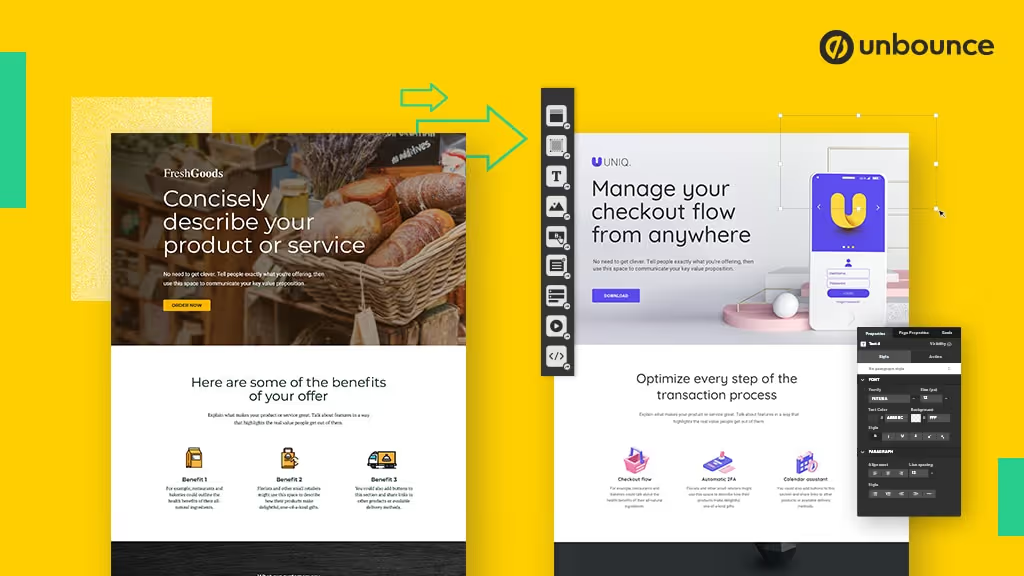
The drag-and-drop builder enables creating professional landing pages without coding. Pre-designed sections, elements, and templates provide starting points that marketers customize to match their brand and campaign needs. The builder offers complete design control while maintaining best practices for conversion optimization.
Templates cover common use cases including lead generation, product launches, event registrations, ebook downloads, webinar signups, and ecommerce sales. Each template incorporates conversion best practices like clear headlines, compelling calls-to-action, social proof placement, and form optimization. Marketers customize templates or build pages from scratch using flexible design tools.
Smart Builder AI Features
Smart Builder leverages artificial intelligence to accelerate landing page creation. Marketers describe their campaign goals and target audience, and AI generates complete landing page copy including headlines, body text, and calls-to-action. The AI understands conversion copywriting principles, creating persuasive content aligned with marketing objectives.
This AI assistance dramatically reduces page creation time from hours to minutes. While AI-generated content requires review and refinement, it provides strong starting points eliminating blank page syndrome. Marketers can regenerate sections, adjust tone, and customize messaging while benefiting from AI understanding of effective conversion copy.
Smart Traffic Technology
Smart Traffic uses machine learning to automatically route visitors to landing page variants most likely to convert them based on their characteristics. Instead of showing all visitors the same page version, Smart Traffic analyzes visitor attributes in real-time and directs each person to the variant that performed best for similar visitors.
This intelligent traffic routing increases overall conversion rates without requiring manual optimization. The system learns continuously, improving predictions as more data accumulates. For advertisers running multiple page variants, Smart Traffic maximizes conversions automatically rather than settling for average performance across all traffic.
A/B Testing Capabilities
Unbounce provides robust A/B testing for comparing different landing page versions to determine which converts better. Marketers can test headlines, images, copy, layouts, forms, calls-to-action, and any other page element. The platform handles traffic splitting, tracks conversions, and provides statistical significance calculations.
Unlike simple A/B testing tools, Unbounce integrates testing with landing page creation. Duplicate pages, make variations, launch tests, and analyze results all within the same platform. This integration makes testing practical for busy marketers who might skip testing if it required complex separate tools.
Popup and Sticky Bar Builder
Beyond landing pages, Unbounce creates popups and sticky bars for existing websites. These overlays capture visitor attention at strategic moments, offering lead magnets, discounts, announcements, or calls-to-action without requiring changes to the underlying website.
Trigger rules control when popups appear based on time on page, scroll depth, exit intent, or specific page visits. This targeting ensures popups appear at optimal moments when visitors are most receptive. The same design flexibility and A/B testing capabilities apply to popups and sticky bars as to full landing pages.
Dynamic Text Replacement
Dynamic Text Replacement automatically customizes landing page content to match visitor search queries or ad campaigns. When someone clicks an ad for "blue running shoes," the landing page headline dynamically updates to mention "blue running shoes" rather than showing generic text.
This personalization increases relevance and conversion rates by creating tighter message match between ads and landing pages. Visitors see content directly addressing their specific interest rather than generic messaging. The feature works with Google Ads, Microsoft Advertising, and other platforms supporting URL parameters.
Form Builder and Integrations
Unbounce includes a flexible form builder supporting various field types, multi-step forms, conditional logic, and custom validation. Forms integrate with hundreds of marketing tools including email platforms, CRMs, marketing automation systems, and analytics tools through native integrations and Zapier connections.
The form builder focuses on conversion optimization with features like smart form fields that reduce friction, progress indicators for multi-step forms, and inline validation providing immediate feedback. Forms can trigger specific integrations based on responses, routing leads to appropriate systems automatically.
Template Library
Unbounce maintains an extensive library of professionally designed templates organized by industry, campaign type, and conversion goal. Templates follow proven conversion patterns and incorporate current design trends. Each template is mobile-responsive and optimized for fast loading.
The template library saves significant time compared to designing from scratch. Marketers select templates matching their needs, customize branding and content, and launch quickly. Templates serve as learning tools showing how effective landing pages structure information, use visual hierarchy, and guide visitors toward conversion actions.
Mobile Responsiveness
All Unbounce landing pages automatically adapt to mobile devices, but the platform goes beyond basic responsiveness. Marketers can customize mobile versions independently, hiding elements, adjusting layouts, or changing content specifically for smaller screens. This mobile-specific optimization ensures pages work excellently on all devices.
Given that mobile traffic often exceeds desktop for many campaigns, mobile optimization directly impacts conversion rates and return on advertising spend. Unbounce makes mobile optimization straightforward rather than an afterthought, treating mobile as a first-class experience.
Page Speed Optimization
Unbounce prioritizes page load speed because even small delays reduce conversion rates significantly. The platform uses content delivery networks, image optimization, lazy loading, and efficient code to ensure fast loading globally. Accelerated Mobile Pages (AMP) support provides ultra-fast mobile experiences for supported page types.
Fast loading particularly matters for paid advertising where slow pages waste ad spend and hurt quality scores. Unbounce handles technical optimization automatically, ensuring marketers achieve good page speed without technical expertise in performance optimization.
Analytics and Reporting
Built-in analytics track visitor behavior, conversion rates, and form submissions. Dashboards show performance metrics at glance including visits, conversions, conversion rates, and trends over time. Integration with Google Analytics, Google Tag Manager, and other analytics platforms enables deeper analysis.
Conversion tracking handles various goal types including form submissions, button clicks, and revenue tracking for ecommerce. Attribution data shows which traffic sources and campaigns drive conversions, helping optimize marketing spend allocation. The analytics focus on metrics that matter for conversion optimization rather than vanity metrics.
Custom Domains and SSL
Landing pages can use custom domains for professional branding and better ad platform quality scores. SSL certificates ensure secure connections, building visitor trust and meeting browser security requirements. Unbounce handles the technical setup, making custom domains and SSL accessible to non-technical marketers.
Using custom domains also improves tracking and attribution by keeping visitors on branded URLs throughout their journey. This professional presentation increases credibility compared to generic subdomains, potentially improving conversion rates.
Collaboration Features
Team collaboration features support multiple users working together on landing pages. Role-based permissions control who can create, edit, publish, or view pages. Comments enable team discussion on specific page elements without email threads or separate tools.
Client access allows agencies to grant clients view-only access to campaigns and performance data without exposing editing capabilities. Approval workflows ensure pages undergo review before publishing. These collaboration features serve agencies and larger marketing teams managing multiple campaigns.
Agency and Client Management
Unbounce provides specific features for agencies managing multiple client accounts. The Client Management Dashboard aggregates data across clients while maintaining separation. Sub-accounts keep client work organized and secure.
White-label options available on higher-tier plans remove Unbounce branding from landing pages and allow agencies to present work as entirely their own. Client reporting provides performance summaries suitable for client presentations without exposing implementation details.
AI Copywriting Assistant
Beyond page generation, Unbounce includes an AI copywriting assistant for refining individual page sections. Marketers can request AI to rewrite headlines, expand bullet points, shorten paragraphs, adjust tone, or generate alternative variations. The AI understands conversion copywriting, creating persuasive text that drives action.
This tool helps marketers who struggle with copywriting or need fresh perspectives on messaging. Rather than replacing human creativity, the AI accelerates the copywriting process and provides options for consideration and refinement.
Integration Ecosystem
Unbounce integrates with major marketing platforms including email services (Mailchimp, ActiveCampaign, HubSpot), CRMs (Salesforce, HubSpot, Pipedrive), webinar platforms (Zoom, GoToWebinar), payment processors (Stripe, PayPal), and analytics tools (Google Analytics, Facebook Pixel). Zapier connectivity extends integration possibilities to thousands of additional applications.
These integrations enable automated workflows where landing page conversions trigger sequences in other tools without manual data transfer. For example, lead submissions can automatically create CRM contacts, add email sequences, notify sales teams, and update dashboards simultaneously.
Pricing Structure
Unbounce offers tiered pricing based on features and conversion volume. The Build plan starts at $99 monthly, including landing pages, popups, sticky bars, and basic features. Experiment plan at $149 monthly adds A/B testing and client sub-accounts. Optimize plan at $249 monthly includes Smart Traffic and AI copywriting.
Concierge plan provides custom pricing with white-label options, dedicated support, and advanced features for agencies and enterprises. All plans include unlimited landing pages and popups, with differences in features rather than volume limits. Free trials let marketers test the platform before committing.
Strengths and Advantages
Unbounce excels at its specialized focus on conversion optimization. Every feature serves the goal of higher conversion rates rather than general website building. The AI-powered tools significantly reduce time to launch while maintaining quality. Smart Traffic provides automatic optimization that manual testing cannot match for speed and sophistication.
The platform handles technical aspects like page speed, mobile responsiveness, and SSL automatically, letting marketers focus on messaging and offers rather than technical details. Extensive integrations connect landing pages to existing marketing stacks seamlessly. The template library and conversion best practices built into the platform help even inexperienced marketers create effective pages.
Limitations and Considerations
Unbounce pricing is higher than general website builders, though justified by specialized conversion features and results. The platform focuses specifically on landing pages and popups rather than full website creation, requiring separate tools for main website needs. Learning curve exists for mastering advanced features like dynamic text replacement and complex integrations.
Design flexibility, while extensive, has some constraints compared to completely custom coding. Very high traffic volumes may incur additional costs. Some users find the interface complex initially though most adapt quickly. These limitations matter less for marketers specifically needing landing page optimization rather than general website building.
Ideal Use Cases
Unbounce works exceptionally well for marketers running paid advertising campaigns on Google Ads, Facebook Ads, LinkedIn Ads, or other platforms where landing page quality directly impacts results. Lead generation campaigns benefit from form optimization and integration features. Product launches can leverage A/B testing to refine messaging quickly.
Agencies managing multiple client campaigns appreciate client management features and white-label options. Ecommerce businesses running promotional campaigns can create dedicated landing pages for specific products or offers. Event organizers can build registration pages with seamless integration to ticketing systems. SaaS companies can test free trial signup flows and optimize conversion funnels.
Getting Started Process
Start with a free trial to explore features without commitment. Choose a template matching your campaign type or start from scratch. Customize design, copy, and calls-to-action for your specific offer. Set up integrations to capture and route leads to your marketing systems.
Configure tracking to measure conversions accurately. Publish to a custom domain or Unbounce subdomain. Drive traffic from advertising campaigns or other sources. Monitor performance and use A/B testing to improve conversion rates over time. Leverage Smart Traffic and AI tools as you become comfortable with the platform.
Comparison with Alternatives
Compared to Leadpages, Unbounce offers more advanced features like Smart Traffic and AI tools but at higher price points. Versus Instapage, Unbounce provides better AI capabilities while Instapage emphasizes collaboration. Against general website builders like Wix or Squarespace, Unbounce delivers superior conversion optimization and testing features specifically for landing pages.
HubSpot includes landing pages but within a broader marketing platform, while Unbounce focuses exclusively on landing page excellence. ClickFunnels emphasizes complete funnel building where Unbounce specializes in individual high-converting pages. The choice depends on whether you need a specialized landing page tool or a more comprehensive platform.
Learning Resources
Unbounce provides extensive educational content helping marketers succeed. The blog covers conversion optimization, copywriting, design, and marketing strategy. The Landing Page Analyzer tool audits pages and provides specific improvement recommendations. Webinars teach best practices and platform features.
Templates include notes explaining design decisions and conversion principles. Help documentation covers every feature with written guides and video tutorials. The Unbounce Community connects users for peer support and idea sharing. These resources make Unbounce not just a tool but a conversion optimization education platform.
Customer Support Quality
Support quality varies by plan tier. All customers access documentation, community forums, and email support. Higher tiers add chat support and faster response times. Concierge plan customers receive dedicated support managers and onboarding assistance.
The support team demonstrates deep knowledge of conversion optimization beyond just technical platform help. They can advise on page design, copywriting, and testing strategy rather than only answering feature questions. This consultative support adds value, especially for marketers new to landing page optimization.
Security and Compliance
Unbounce implements strong security measures including automatic SSL certificates, data encryption, and regular security audits. The platform complies with GDPR and provides features for managing visitor consent and data privacy. SOC 2 Type II certification demonstrates commitment to security and privacy standards.
For marketers in regulated industries or handling sensitive information, these security measures and compliance certifications ensure landing pages meet necessary requirements. Regular platform updates address security vulnerabilities promptly, maintaining trust and protection.
Performance and Reliability
Unbounce maintains strong uptime reliability with content delivery networks ensuring fast global performance. Page load speeds consistently achieve good scores in performance testing. The infrastructure handles traffic spikes from successful campaigns without slowdowns or downtime.
This reliability matters critically for paid advertising where downtime or slow pages waste budget and lose conversions. The platform provides status page transparency about any issues and maintains historical uptime data demonstrating consistent reliability.
Recent Updates and Innovation
Unbounce actively develops new features, with recent additions including enhanced AI capabilities, improved mobile editing, expanded integration options, and updated templates. The company invests heavily in AI and machine learning, positioning the platform at the forefront of automated conversion optimization.
This commitment to innovation means Unbounce evolves rather than stagnating. New features address emerging marketing challenges and opportunities, ensuring the platform remains valuable as marketing practices change. Following the product roadmap helps users anticipate upcoming capabilities.
Return on Investment Considerations
While Unbounce costs more than basic landing page tools, the return on investment comes from higher conversion rates. A campaign spending $10,000 monthly on ads that improves conversion rate from 3% to 5% through better landing pages generates significantly more value than the platform cost.
Smart Traffic and A/B testing features can improve results beyond what manual optimization achieves, especially for marketers lacking optimization expertise. For businesses running substantial advertising budgets, the marginal improvement in conversion rates quickly justifies platform costs through increased revenue and better return on ad spend.
Best Practices for Success
Success with Unbounce requires following conversion optimization best practices. Start with clear value propositions and compelling headlines. Use high-quality images and videos. Minimize form fields to reduce friction. Include social proof through testimonials and trust indicators. Create strong calls-to-action using action-oriented language.
Test regularly, changing one element at time to understand what drives results. Use dynamic text replacement to improve message match. Optimize for mobile devices specifically. Monitor page speed and maintain fast loading. Connect pages to proper integrations ensuring leads flow to appropriate systems. Apply learnings from tests to future pages.
Common Mistakes to Avoid
New users often make mistakes that reduce effectiveness. Creating overly complex pages with too much information overwhelms visitors. Neglecting mobile optimization loses conversions from mobile traffic. Running too many simultaneous tests dilutes results and delays learning. Skipping integrations creates manual work and data gaps.
Using generic messaging rather than specific value propositions fails to persuade. Launching pages without tracking prevents measuring success. Changing too many elements in single tests makes results uninterpretable. Ignoring page speed impacts conversion rates negatively. Avoiding these mistakes accelerates success with the platform.
Final Verdict
Unbounce delivers on its promise as a specialized landing page builder for conversion-focused marketers. The AI-powered features, Smart Traffic technology, and comprehensive A/B testing capabilities provide sophisticated optimization that justifies the premium pricing for businesses running meaningful advertising budgets. The platform handles technical complexity while providing creative flexibility.
The specialization means Unbounce excels at landing pages specifically rather than serving as a general website builder. For marketers needing the best possible landing page conversion rates, Unbounce deserves serious consideration despite higher costs. The return on investment through improved conversion rates makes the platform valuable for businesses taking landing page optimization seriously.
Is Unbounce Right for You
Unbounce fits best if you run paid advertising campaigns where landing page quality impacts results, manage significant advertising budgets where small conversion improvements have large revenue impact, need sophisticated A/B testing and optimization features, or value AI-powered tools for faster page creation and optimization.
Skip Unbounce if you need a full website builder rather than specialized landing pages, run minimal advertising where conversion optimization has limited impact, prefer simple tools over feature-rich platforms, or have very limited budgets. Start with the free trial to evaluate whether the conversion optimization features justify costs for your specific marketing needs and budget.
Start Your Webflow Journey
Discover the power of Webflow and begin creating beautiful, responsive websites today. Click below to get started directly on Webflow’s platform.
You Might Also Like
Explore our recommended articles for more Webflow tips, tricks, and inspiration to enhance your design workflow.