From Idea to MVP in 48 Hours: The Vibe Coding Stack Builders Are Actually Using
.jpg)
There's a new rhythm in the maker world. It doesn't involve sprints, standups, or six-month roadmaps. It involves a founder with a clear idea, a few AI-powered tools, and a weekend.
Vibe coding, a term that describes the practice of building software through natural language prompts, has moved from Twitter meme to genuine production strategy. In 2026, non-technical founders are shipping real products — not prototypes, not demos, actual working SaaS tools — in 48 hours or less.
Here's how it actually works, what the stack looks like, and where Webflow fits into the picture.
What Vibe Coding Actually Means
The phrase was coined (half-jokingly) to describe the experience of working with AI coding tools where you describe what you want and the AI figures out the implementation. You're not writing syntax. You're directing intent.
In practice, vibe coding isn't about avoiding all technical decisions. It's about changing the bottleneck. Instead of "can I build this?" the question becomes "is this the right thing to build?"
For builders, that's a massive shift.
The Modern Vibe Coding Stack
Builders aren't picking one tool and calling it done. The best 48-hour MVPs come from a coordinated stack:
Frontend and Marketing Layer
- Webflow for the public-facing site, landing page, and CMS
- No hand-written HTML needed — components, animations, and responsiveness handled visually
Logic and Backend
- Cursor or Windsurf for generating app logic, API routes, and database schemas through natural language prompts
- Supabase for backend-as-a-service: auth, database, and storage without spinning up infrastructure
Automation and Integration
- Make (formerly Integromat) or n8n for connecting services, triggering workflows, and handling edge cases
- OpenAI API for any AI-powered features embedded in the product
Distribution
- Webflow CMS for blog content and SEO
- Beehiiv or ConvertKit for email capture and onboarding
The pattern here: every tool in this stack removes one category of friction. You're not solving infrastructure. You're not debugging build pipelines. You're focused entirely on whether the product makes sense.
A Real 48-Hour Example
Here's a realistic timeline for a founder building a micro-SaaS: a tool that analyzes freelancer invoices and suggests when to raise rates.
Hour 0-4: Define the core loop
Write a one-paragraph description of what the product does, who it's for, and what success looks like. This isn't a spec doc — it's a prompt for everything else.
Hour 4-12: Build the backend
Open Cursor. Describe the data model: a freelancer uploads invoice data, the system calculates average project value, compares it against rates from a benchmark dataset, and returns a recommendation. Cursor generates the schema, the logic, and the API endpoints. Supabase handles auth and storage.
Hour 12-20: Build the front end
Open Webflow. Create a landing page with a waitlist form. Keep it to five sections: headline, problem, solution, social proof (even one placeholder), and CTA. Push it live before the backend is even finished.
Hour 20-36: Connect everything
Use Make to handle the form submission, Supabase write, and welcome email sequence. Embed the app interface into a Webflow page or point a subdomain at the deployed app.
Hour 36-48: Soft launch
Post in three communities. Not "I built a thing," but "I'm looking for 10 freelancers who struggle to know when to raise rates." Let real users tell you what's broken.
Where Most People Go Wrong
They over-polish before anyone's seen it.
The vibe coding mentality breaks down when founders spend hour 30 tweaking button radius instead of getting the product in front of someone. Done beats perfect every single time.
They treat Webflow as decoration.
The landing page isn't a formality. It's the first test of the idea. If you can't write a clear headline about what your product does, the product idea itself probably needs more thought.
They pick the wrong complexity level.
Vibe coding works exceptionally well for tools with a clear, bounded use case. "Invoice analyzer" works. "All-in-one business OS" doesn't — not in 48 hours.
They skip distribution planning.
Shipping without knowing where your first 100 users will come from is the most common mistake. Before you write a single prompt, answer: where do my users spend time, and how do they find tools like this?
Webflow's Role in the Vibe Coding Era
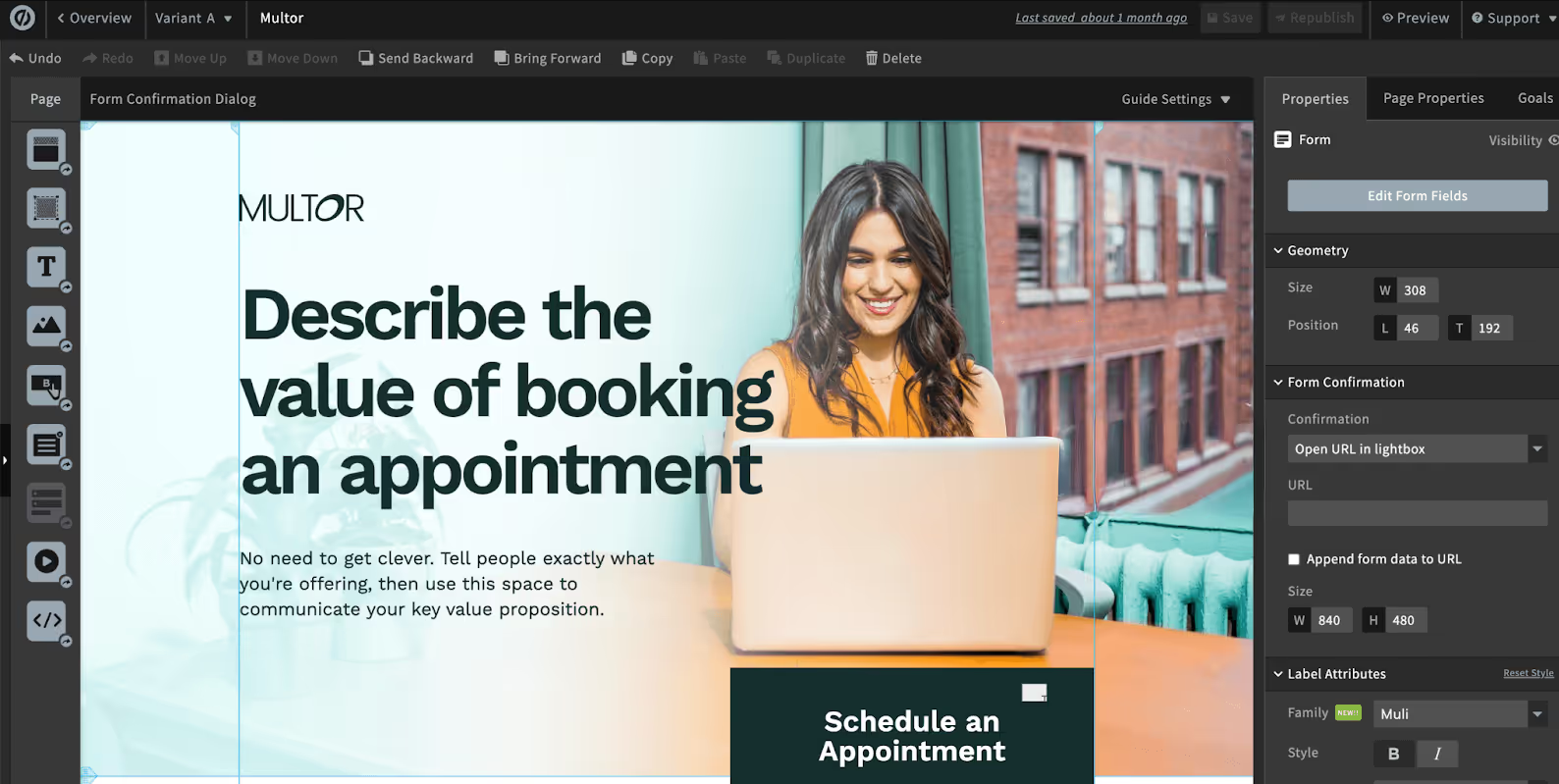
Something interesting is happening in the no-code world. Webflow has quietly become the default credibility layer for vibe-coded products.
When someone builds a tool over a weekend using Cursor and Supabase, the thing that makes it look like a real company isn't the app itself — it's the marketing site. Webflow's visual quality makes rough-around-the-edges apps feel polished and intentional.
This matters for conversion. A landing page that looks like it belongs to a funded startup, even if the product behind it is a two-day build, creates the trust required for early adopters to sign up with their email.
The combination is powerful: Cursor handles the logic, Webflow handles the story.
What This Means for Product Thinking
Vibe coding isn't just a faster way to build. It changes what kinds of ideas are worth pursuing.
When the cost of building a prototype was weeks of engineering time, only ideas with strong conviction got built. Now, the cost is closer to a weekend. That means:
- More experiments get run
- Market feedback comes faster
- Pivots happen before significant investment
- Founders learn by doing, not by planning
The skill that matters most in this environment isn't coding ability, design talent, or even marketing instinct. It's judgment: knowing which idea is worth 48 hours, reading early signals accurately, and deciding when to keep building versus when to cut.
Final Takeaway
Vibe coding has made the builder era real. Not theoretical, not coming soon — real and happening right now.
The tools exist. The stack is proven. The path from "I have an idea" to "people are using this" has never been shorter.
The only question is whether you're willing to ship something imperfect on Monday that could become something real by Friday.
That's the vibe.
Start Your Webflow Journey
Discover the power of Webflow and begin creating beautiful, responsive websites today. Click below to get started directly on Webflow’s platform.
You Might Also Like
Explore our recommended articles for more Webflow tips, tricks, and inspiration to enhance your design workflow.