The Productized Service Playbook: How Webflow Freelancers Are Escaping the Hourly Rate Trap

There is a ceiling on hourly billing. It is not a soft ceiling built from your ability to find clients or your ability to execute. It is a mathematical one: you only have so many hours, and every single one of them has to be sold and worked.
The freelancers who break past this ceiling are not working more. They are working differently. They have moved from billing time to selling outcomes, by productizing their services.
This shift is not new. But in 2026, with Webflow as the dominant platform for independent web builders and AI accelerating delivery speed, productized services have become the most practical leverage point for any freelancer who wants to grow without grinding.
What a Productized Service Actually Is
A productized service is a fixed-scope, fixed-price offer built around a specific deliverable. Instead of quoting every project individually, you define exactly what you build, for whom, on what timeline, and at what price. Every client buys the same thing. Every engagement follows the same process.
For a Webflow freelancer, a productized offer might look like this:
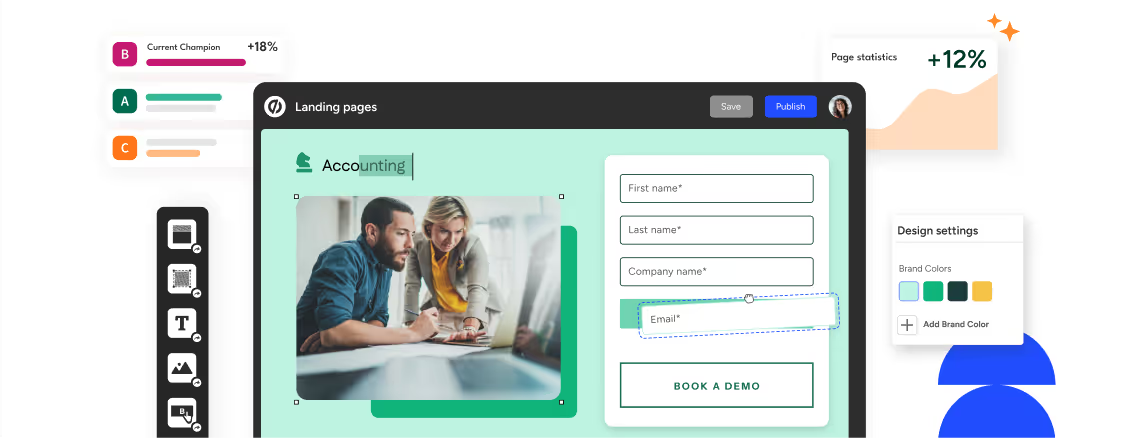
"Webflow Landing Page Sprint: One high-converting landing page, built in Webflow, delivered in five business days. Fixed price: $1,800."
That is it. No hourly estimate. No scope negotiation. No debates about revision rounds. One price, one outcome, one timeline.
Why Hourly Billing Is the Wrong Model for Skilled Work
Hourly billing has a fundamental flaw: it punishes expertise. The better you get, the faster you work. The faster you work, the less you earn per project at the same hourly rate.
A junior Webflow developer might take 20 hours to build a landing page. A senior one takes 8. At $100/hour, the junior earns $2,000 and the senior earns $800 for the same result. The client values the outcome, not the hours. But the hourly model charges for the hours.
Productized services flip this. When you charge $1,800 for a landing page, your expertise does not penalize you. It expands your margin. The same project that took you 20 hours two years ago now takes 8. Same revenue, more capacity.
The Three Core Components of a Strong Productized Offer
Building a productized service is a product design exercise, not a service packaging exercise. You are designing a repeatable system, not wrapping existing work in a new label.
1. A Specific, Measurable Deliverable
The offer has to be concrete enough that both parties know exactly what success looks like. "A Webflow website" is not specific. "A five-page Webflow site built to your existing brand guidelines, including homepage, about, services, contact, and blog template, delivered in 10 business days" is specific.
Specificity removes ambiguity. Ambiguity is where scope creep lives.
2. A Fixed Process
A productized service is only sustainable if you can deliver it consistently. That means having a defined process: an intake form, a content brief template, a review cycle structure, and a handoff checklist.
The process is the product. When your process is solid, the service becomes predictable in both quality and delivery time. This is what lets you take on multiple clients simultaneously without losing control of any engagement.
3. Clear Scope Limits
Every productized service needs explicit edges. What is included. What is not. How many revision rounds. What happens if the client is late with content.
These limits are not unfriendly. They are what make the fixed price possible. When clients understand the scope upfront, they respect it. The misaligned expectations that create difficult freelance relationships almost always come from scope that was never defined.
Building Your First Productized Offer
Start with the work you do most often and enjoy most. Not the work you think sounds impressive. The work you could deliver in your sleep.
For most Webflow freelancers, this might be:
- Landing page builds for SaaS and startup clients
- CMS-driven blog setup and content migration
- Performance audit and Core Web Vitals optimization
- Webflow site redesign from existing brand assets
- Membership site setup using Memberstack or Outseta
Pick one. Strip it down to a clear scope. Price it at what you would charge a client you like, not a client you are trying to win. Build the intake form and the process documentation. Then sell it.
The first engagement will reveal what needs to be tightened. The second will be smoother. By the fifth, the process runs itself.
Pricing Your Productized Service
Most freelancers underprice their first productized offer because fixed prices feel more exposed than hourly estimates. If you are wrong on an hourly project, the client pays the extra hours. If you are wrong on a fixed-price service, you absorb the cost.
This is true. It is also why your process matters more than your price.
When you know your delivery process precisely, you know how long it takes. When you know how long it takes, you know what you need to charge. Build in a buffer for the first three engagements while your process stabilizes, then tighten the price as your confidence in the scope grows.
A useful pricing heuristic for Webflow productized services in 2026: charge for the outcome value, not the time cost. A landing page that generates leads for a business is worth far more than eight hours of a designer's time. Price it closer to the former.
How Webflow Makes This Model Work
Webflow is a uniquely strong foundation for productized services because of how well it handles repeatable builds.
Template systems and cloneables mean you can start every landing page or site build from a pre-structured foundation rather than from scratch. Your variables and class system, set up once, apply consistently across every engagement. Webflow Symbols let you maintain component consistency without rebuilding each time.
The result: your delivery time compresses with every engagement. You are not just getting faster. The system is doing more of the work.
Pair this with a standard intake workflow: a form built in Webflow or Notion, a content brief sent via email, a Loom walkthrough at handoff. You have a delivery system that looks professional to every client regardless of your current workload.
From Freelancer to Studio: The Scaling Path
Once a productized service is running smoothly, it becomes a building block for a broader business. You can run multiple offers simultaneously, each with its own scope and pricing. You can hand pieces of the delivery to contractors without losing consistency because the process is documented. You can sell add-ons and retainers to clients who need ongoing support after the core engagement.
This is how solo freelancers grow into studios without hiring full-time employees. The productized service model handles the core delivery. Contractors handle overflow. Retainers provide recurring revenue. The business gets more durable without getting more complicated.
Takeaway
Hourly billing was the default because it felt safe. The client pays for what you do. The freelancer gets compensated for every hour worked. In practice, it creates misaligned incentives, unpredictable income, and a ceiling that rises slowly if it rises at all.
Productized services create a different set of defaults: scoped projects, predictable revenue, and a delivery system that gets more efficient over time. For Webflow freelancers in 2026, the tools to build this model are already in your stack. The only thing left is the decision to design your work like a product.
Start with one offer. Deliver it five times. Iterate. The ceiling you felt before will start to look like something you built yourself.
Start Your Webflow Journey
Discover the power of Webflow and begin creating beautiful, responsive websites today. Click below to get started directly on Webflow’s platform.
You Might Also Like
Explore our recommended articles for more Webflow tips, tricks, and inspiration to enhance your design workflow.