The Zero-Designer Startup: How Modern Founders Ship Beautiful Products Without Hiring Design

Five years ago, launching a product without a designer meant shipping something that looked broken. Today, a solo founder can ship a product that looks like it came out of a Series A-funded design team in a single week. The tools changed. The playbook changed. And the barrier between "idea" and "polished product" is lower than it has ever been.
The Old Assumption Is Broken
The old model assumed a linear pipeline: idea, wireframe, designer, developer, launch. That model was slow, expensive, and fragile. Every handoff was a delay. Every design revision was a negotiation.
Modern founders have replaced that pipeline with a tighter loop: idea, component library, prototype, ship. The tools close the gap between design intent and production output. You no longer need a specialist to produce something that converts.
What "Zero-Designer" Actually Means
This is not about ignoring design. It is about distributing design decisions across better defaults.
The zero-designer startup leans on:
- Component libraries with strong defaults — Tailwind UI, Webflow built-in classes, Radix UI
- Design systems at the framework level — where spacing, typography, and color are pre-solved
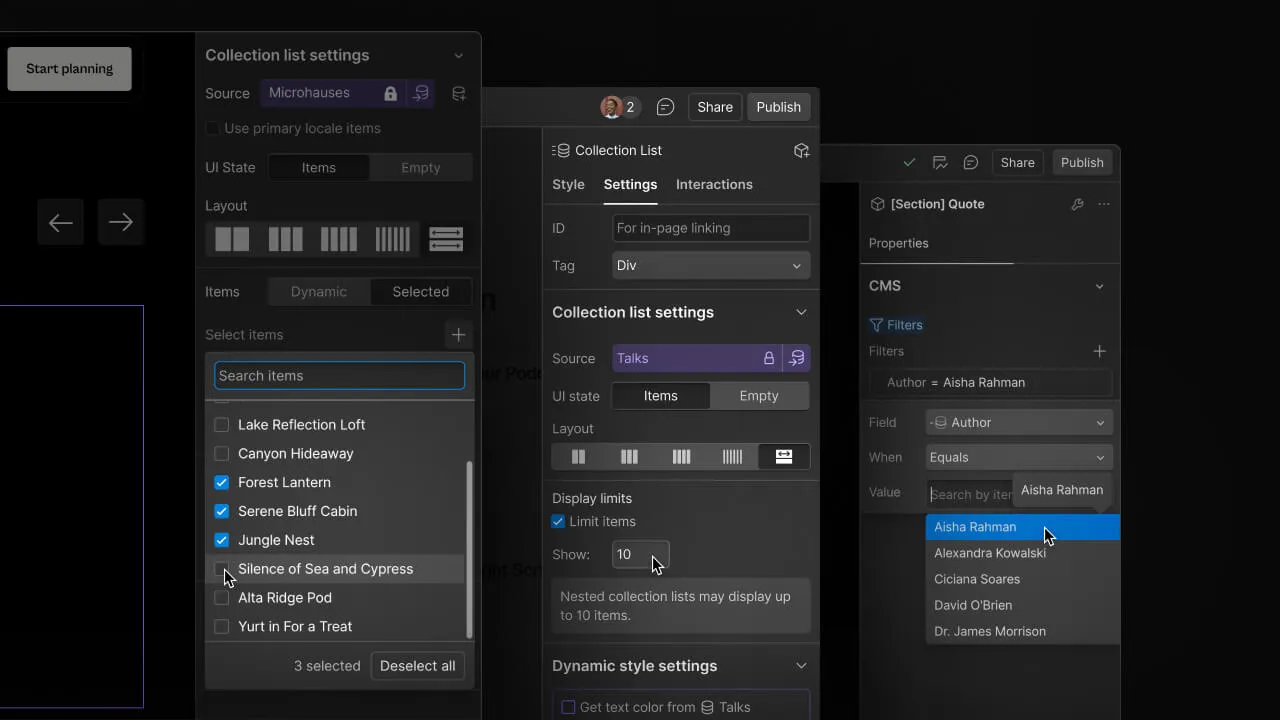
- AI-assisted layout generation — tools like v0.dev, Builder.io, and Webflow AI that generate production-ready UI from prompts
- No-code CMS and page builders — where content and layout decisions are separated and iterable
The founder is not doing less design work. They are doing design work at a higher altitude — making product decisions rather than pixel decisions.
The Stack That Makes It Work
Here is a realistic zero-designer stack for a B2B SaaS or content-driven product in 2026:
Visual layer: Webflow for marketing site and CMS, plus a pre-built template that has already solved color, type, and spacing.
Product UI: Next.js with shadcn/ui or Tailwind and Radix — component primitives with sensible visual defaults baked in.
AI design assist: Claude for copy, v0.dev for component generation, Midjourney or Flux for hero imagery.
Content ops: Webflow CMS for blog and landing pages, Notion for internal documentation.
Iteration loop: Ship, watch session recordings, adjust layout or copy, ship again. No design tickets. No Figma handoffs.
Where Most Founders Get This Wrong
The trap is over-customizing before validating. Founders spend two weeks tweaking font pairings and hero section gradients for a product that has not had a single real user yet.
The zero-designer approach works because it enforces a discipline: ship at 80% visual polish, validate the product, then invest in design once you know what you are actually building.
The other common mistake is confusing "no designer" with "no design system." You still need consistency. The difference is you are borrowing someone else's design system — Webflow templates, Tailwind, shadcn — instead of building your own from scratch. That is a feature, not a compromise.
What You Still Cannot Skip
There are three design decisions that founders genuinely need to make well, even without a dedicated designer:
- Typography hierarchy — Headings, body text, and captions need visual contrast. A single font family with three weights is enough to create clarity.
- Whitespace — Cramped layouts signal low quality instantly. Use more padding than feels comfortable on first instinct.
- One strong CTA — Every page should have one primary action. If it is not immediately obvious to a stranger, the page is not done.
These are not designer decisions. They are product decisions with a visual expression. Any founder can get them right with a solid template as scaffolding and an hour of focused attention.
When to Actually Hire a Designer
The zero-designer approach has a ceiling. Here is when to break the pattern:
- You have validated product-market fit and need a brand identity that scales across channels
- Your product UI involves complex interactions that standard template components cannot handle
- You are in an industry where visual trust signals are primary, such as fintech, healthcare, or enterprise SaaS
- You are preparing for a funding round where first impressions carry significant weight
Until then? Ship with templates. Borrow proven design systems. Use AI assists liberally. Spend your limited budget on distribution and user research, not custom Figma hours.
Final Takeaway
The zero-designer startup is not about cutting corners. It is about allocating attention correctly at the right stage of the business. Design matters deeply — but many design decisions can be pre-solved by great tools, templates, and borrowed systems. What cannot be pre-solved is your product judgment, your positioning, and your genuine understanding of what your customers actually need.
Ship something beautiful enough to not get in the way. Then go talk to users. The design investment comes after the insight, not before it.
Start Your Webflow Journey
Discover the power of Webflow and begin creating beautiful, responsive websites today. Click below to get started directly on Webflow’s platform.
You Might Also Like
Explore our recommended articles for more Webflow tips, tricks, and inspiration to enhance your design workflow.