The Speed Moat: Why Shipping Faster Is the Only Competitive Advantage That Compounds

There is a question every builder eventually asks
How do I compete with teams 10x my size?
The instinctive answers are wrong. Better design. More features. Lower prices. These work at the margins, but they are all positions that can be copied. There is one advantage, however, that gets harder to replicate the more you use it: speed.
Speed is not just about moving fast. It is about compounding. Every time you ship, you learn. Every time you learn, the next ship is better. Every time you iterate, you pull further ahead of builders who are still debating their product roadmap.
This is the speed moat. And no-code builders are uniquely positioned to build one.
Why Speed Is a Moat, Not Just a Tactic
Moats are structural advantages that become harder to overcome over time. Network effects. Brand trust. Proprietary data. Speed fits this definition for one reason: it creates a feedback loop that accelerates learning.
Consider two builders launching competing tools. Builder A ships in three months after polishing every feature. Builder B ships in three weeks with a focused MVP, collects user feedback, and ships again in another two weeks.
By month three, Builder A has one data point: their launch. Builder B has four or five iterations, real customer data, and a product that has already adapted to what the market actually wants.
This is not a hypothetical. This is how the best indie products on the market today were built. Not perfectly. Repeatedly.
The No-Code Speed Advantage Is Still Underused
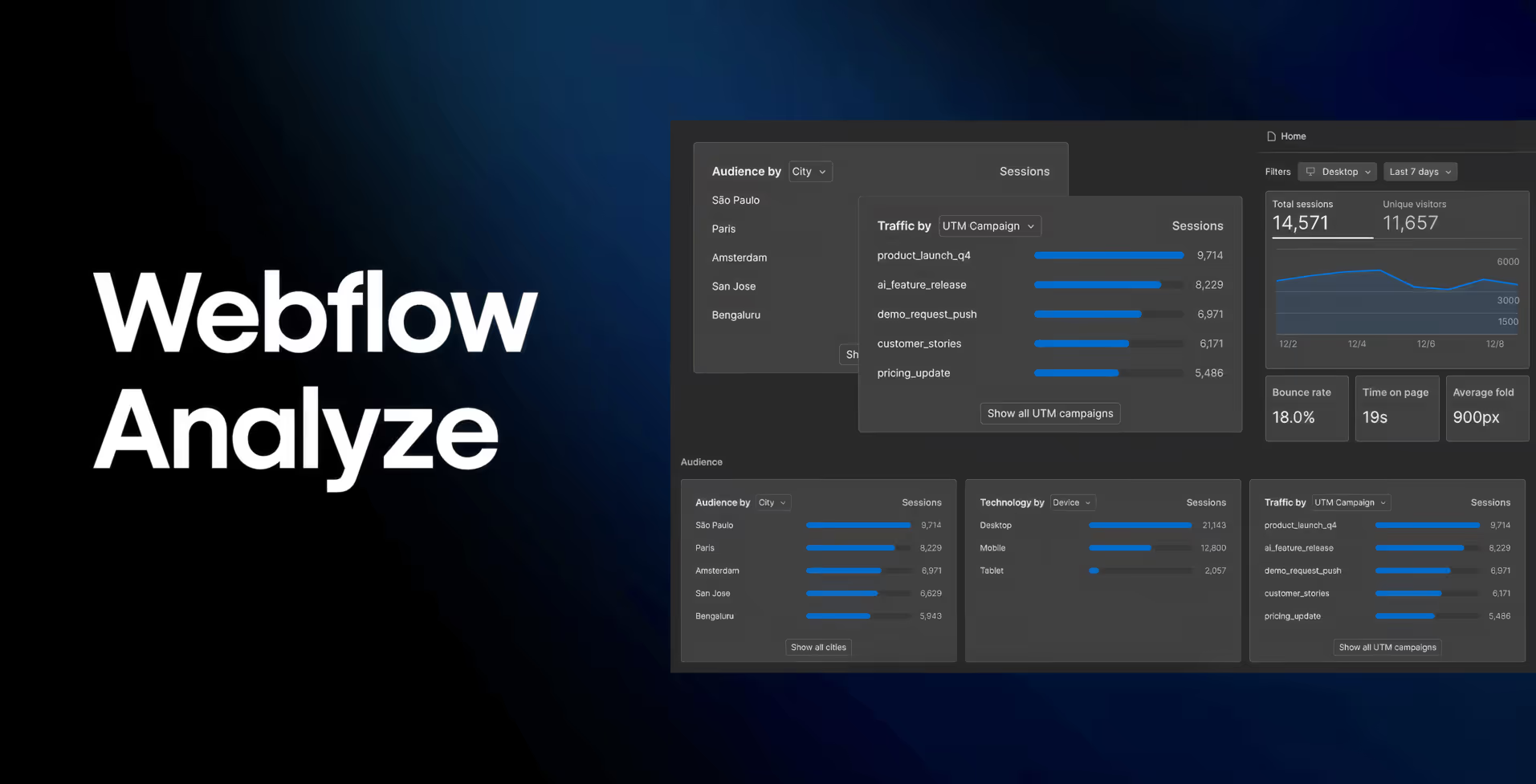
No-code tools exist to reduce the gap between idea and execution. Webflow, for instance, collapses what used to require a designer, a developer, and a project manager into a single workflow. But many builders still treat no-code as a shortcut to a finished product rather than as a machine for continuous shipping.
The real unlock is treating your stack as a shipping system, not a build system.
A shipping system asks: How quickly can we go from a new idea to something live? A build system asks: How do we make this perfect before we launch?
The best no-code builders optimize for the first question. They build reusable components. They establish clear CMS structures from day one. They create templates for landing pages that can be duplicated and customized in hours. Every future ship gets faster because they invested in the infrastructure of speed.
What Shipping Fast Actually Means in Practice
Speed is not the same as sloppiness. The goal is not to ship garbage quickly. The goal is to ship the smallest version of a bet that can return useful information.
Here is what this looks like concretely:
- New feature idea? Do not build it. Build a landing page for it first. See if anyone signs up. If they do, build the minimum version. If they do not, you saved weeks.
- New product vertical? Use Webflow CMS to spin up a microsite in a day. Drive a small amount of paid traffic. Measure conversion before writing a line of logic.
- New content strategy? Publish three posts in three days instead of spending three weeks on one perfect post. See what resonates. Double down on what does.
The pattern is the same: use speed to generate signal, then use signal to justify effort.
The Compounding Effect Builders Underestimate
Here is where the moat metaphor really earns its keep.
Every iteration you ship, you get slightly better at shipping. Your Webflow component library grows. Your content templates get sharper. Your product decisions get faster because you have made similar ones before.
More importantly, your market understanding compounds. You stop guessing what users want because you have shipped to them enough times to have a real picture. Your positioning becomes sharper. Your onboarding gets tighter. Your pricing starts to make sense.
Builders who ship slowly are always working with old information. Builders who ship fast are running a continuous research operation.
After six months, this gap is visible. After two years, it is uncrossable.
Building a Speed System in Webflow
The no-code stack rewards speed-first builders. Here is how to structure Webflow specifically as a speed machine:
- Component libraries over one-offs. Every time you build a section, ask yourself: will I need this again? If yes, save it as a symbol. The second site you build should take half as long as the first.
- CMS-first thinking. Before you design a page, ask whether the content it displays should live in the CMS. If it is repeatable, it should. This means you can add ten new case studies, blog posts, or product pages without touching design.
- Global styles as speed rails. Typography, color, spacing: set these once, globally. When you need to move fast, you are not making design decisions. You are selecting from a vocabulary you already built.
- Staging-to-live speed. Webflow's publishing workflow is fast by default. For solo builders and small teams, ship to staging, review for ten minutes, go live. Done.
Speed Requires Clarity, Not Chaos
One misconception worth addressing: shipping fast requires more clarity, not less.
Builders who ship slowly often do so because they have not answered the hard questions. Who is this for? What problem does it solve? How will people find it? When these are unclear, every decision requires rethinking from scratch.
Speed demands that you answer these questions early and guard them fiercely. When a new feature request comes in, the first question is: does this serve the person we have already decided we are building for? If yes, ship it fast. If no, say no fast.
Discipline about scope is what makes speed possible. Saying no quickly is shipping fast in another form.
The Builder Who Wins in 2026
The competitive landscape for builders has never been more crowded. AI tools have dramatically lowered the barrier to entry. There are more products, more landing pages, more tools competing for the same attention.
In this environment, the builder who wins is not the one with the most features or the slickest design. It is the builder who has learned more than anyone else about what their specific audience actually needs and who keeps learning faster than anyone can copy.
That is the speed moat. It is not a sprint. It is a system. And once you build it, it works for you every day.
Ship something this week. Then ship something better next week. The compound interest starts from the first iteration.
Start Your Webflow Journey
Discover the power of Webflow and begin creating beautiful, responsive websites today. Click below to get started directly on Webflow’s platform.
You Might Also Like
Explore our recommended articles for more Webflow tips, tricks, and inspiration to enhance your design workflow.