The New Rules of Product-Led Growth for No-Code Startups
For a long time, product-led growth (PLG) was a strategy reserved for well-funded SaaS teams with engineering resources to spare. Freemium tiers, onboarding flows, in-app upsells — these were built by developers, owned by growth teams, and measured by data scientists. Solo founders and small no-code teams watched from the sidelines.
That has changed. In 2026, the tools available to no-code builders have made PLG not just accessible but surprisingly practical, even for one-person operations. If you are building a digital product without engineers, this playbook is now yours.
What Product-Led Growth Actually Means
Before getting into tactics, it is worth clearing up a common misunderstanding. PLG is not the same as "build it and they will come." It is a go-to-market strategy where the product itself drives acquisition, activation, and retention, rather than relying primarily on sales or marketing. The product does the convincing.
In practice, this usually means a free tier or trial that lets users experience real value before paying, onboarding that guides users to their first meaningful outcome quickly, natural expansion paths where more usage leads to upgrades, and built-in sharing or collaboration features that spread the product organically.
The classic examples are Notion, Figma, Calendly, and Loom. All of them grew substantially through product usage rather than traditional advertising. The question for no-code founders is: how much of that playbook can you actually replicate without a dev team?
Why No-Code Changes the Equation
The reason PLG was hard for small teams was execution complexity. Building a proper onboarding flow, a usage-based paywall, or a referral mechanism used to require significant engineering effort. You needed backend logic, payment integrations, analytics pipelines, and custom UI.
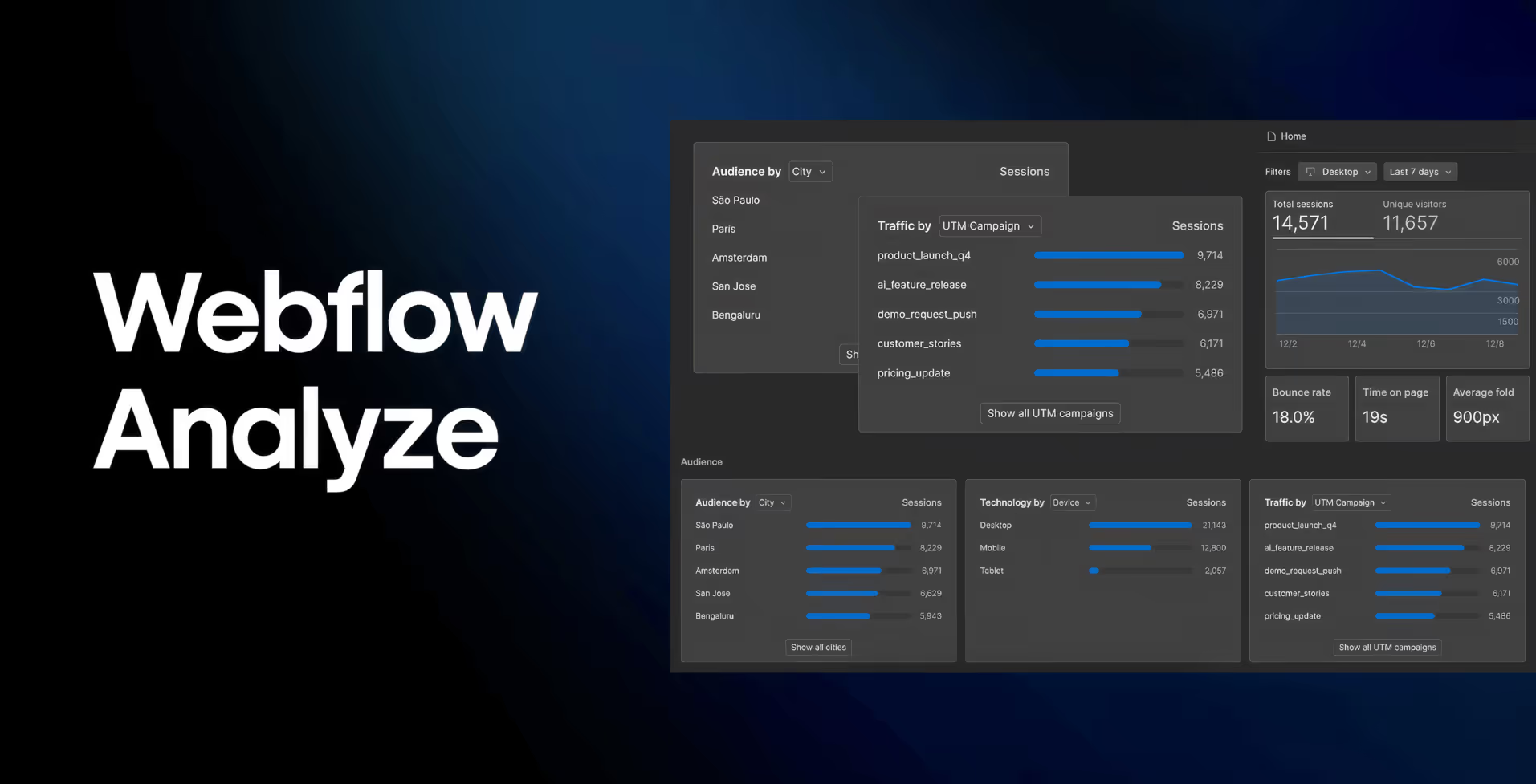
No-code platforms have compressed this dramatically. A founder using Webflow for their marketing site, combined with tools like Memberstack or Outseta for authentication and payments, can now assemble a credible PLG experience without writing a single line of code. Add Lemon Squeezy for payment processing and Loops for behavioral email triggers, and you have a surprisingly complete growth infrastructure.
This is not hypothetical. A growing number of micro-SaaS products in 2026 are running meaningful revenue on stacks that would have required a full team just three years ago.
The Core PLG Moves for No-Code Founders
Lead with genuine free value
The foundation of PLG is a free experience that actually demonstrates your product's value. Not a watered-down demo, but something that solves a real slice of the problem. Users need to reach what PLG practitioners call the "aha moment" — the point where they understand, from firsthand experience, why the product matters.
For no-code tools, this often means offering a limited free tier with real functionality: one project, a few records, a basic plan. The goal is to let the product speak before the sales pitch begins.
Shorten the path to value
Onboarding is where most early-stage products lose people. If a new user has to spend more than a few minutes before seeing something useful, many will leave. No-code founders have an advantage here: tools like Webflow, Framer, or Softr make it relatively fast to build clean, focused onboarding screens.
The key is removing every step that is not strictly necessary before the user experiences the core value. Think about what the minimum viable onboarding looks like. What is the one thing a new user needs to do to understand why they should stay?
Build in natural sharing loops
The most cost-effective growth lever in PLG is when users bring other users. This can be explicit (referral programs) or implicit (collaboration features that require inviting teammates, or outputs that carry your branding).
For no-code products, a simple "Powered by [your product]" attribution on public-facing outputs is a classic move. So is building any kind of collaborative workspace where the value increases with more participants. Even a simple share link can create a discovery loop if the shared content is compelling enough.
Use behavioral triggers, not blast emails
Generic email newsletters rarely move the needle for activation. What works in PLG is sending the right message at the right moment based on what a user has or has not done. Did someone sign up but never complete setup? Did a free user hit the usage limit three times in a week? These are moments to act.
With tools like Loops, Customer.io, or Webflow's logic integrations, no-code founders can now build relatively sophisticated behavioral email sequences. The principle is simple: send fewer, more relevant messages instead of broadcasting to everyone.
Measure what actually drives upgrades
PLG requires knowing which user behaviors correlate with conversion. The standard metric is PQL (product qualified lead), which describes a free user whose behavior signals they are ready to pay. This could be heavy usage, repeated visits to a premium feature gate, or consistent team activity.
You do not need a data warehouse to track this. Tools like Mixpanel, Amplitude, or even a well-structured Airtable with basic integrations can get you most of the way there. The goal is to identify one or two signals that reliably predict conversion, then orient your product experience around helping users reach them faster.
Common Pitfalls for No-Code PLG Builders
The biggest mistake is assuming PLG means "free forever." That is a pricing decision, not a growth strategy. If your free tier is too generous, users never feel the reason to upgrade. If it is too restrictive, they never experience enough value to want to.
Another common issue is treating activation as a one-time event. Getting a user to sign up is not the same as getting them to succeed. PLG requires sustained focus on what happens in the first few days and weeks of a user's experience, not just at the moment of registration.
Finally, no-code founders often underestimate the role of copy. The language inside your product, on your pricing page, and in your onboarding emails shapes whether users understand what they are getting and why it is worth paying for. Clear, specific copy consistently outperforms clever or vague copy in PLG contexts.
The Opportunity Ahead
There has never been a better moment for no-code founders to build with a PLG mindset. The tools exist, the patterns are proven, and the market expectation — especially among B2B buyers and prosumer audiences — is increasingly that they can try before they buy.
The shift from "launch and hope" to "build the product into the growth engine" is one of the more durable lessons from the last decade of SaaS. And now, for the first time, it is genuinely within reach for builders who write no code at all. The playbook has not changed. What has changed is who gets to run it.
Start Your Webflow Journey
Discover the power of Webflow and begin creating beautiful, responsive websites today. Click below to get started directly on Webflow’s platform.
You Might Also Like
Explore our recommended articles for more Webflow tips, tricks, and inspiration to enhance your design workflow.